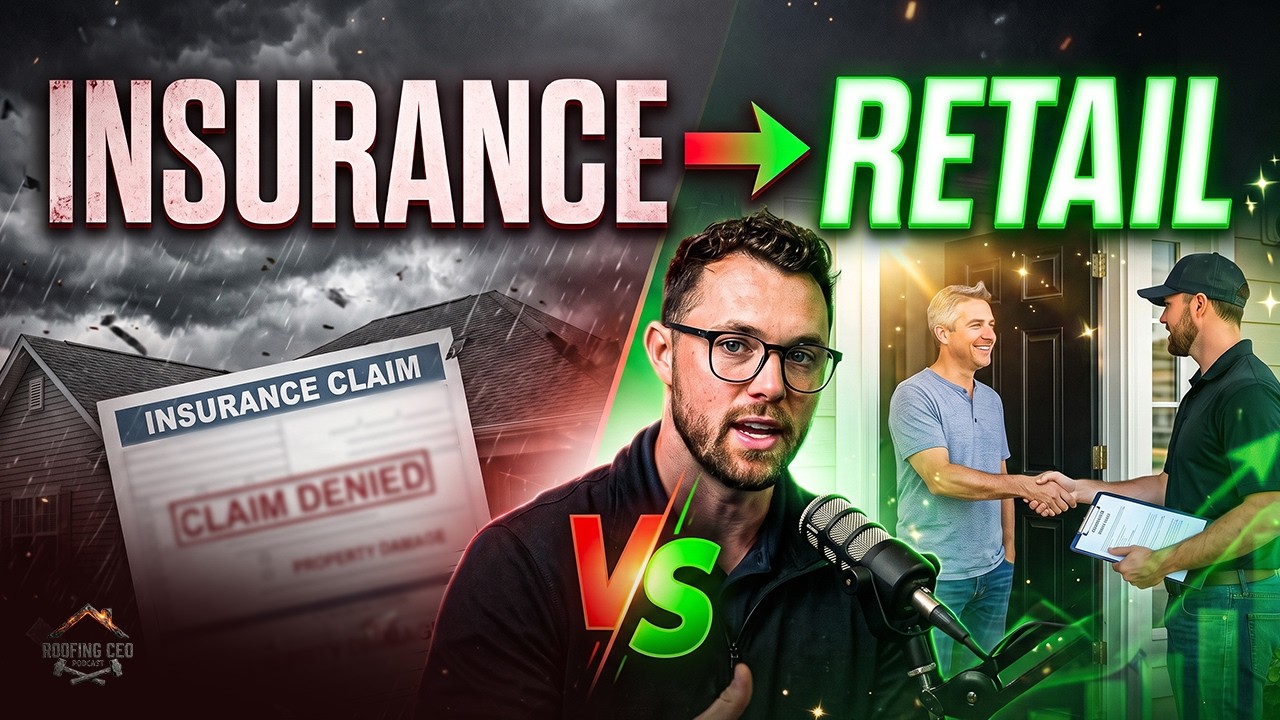
How to Switch a Roofing Company From Insurance to Retail: Jake Denning's Eight-Month Shift

- The shift: Jake Denning moved All Ears Roofing from roughly 90% insurance work to 90% retail over about eight months, without pulling the plug on the insurance revenue that was still coming in.
- The rebuild: Retail forced a new machine. Canvassing and selling became separate jobs, reps now run one to three lead-fed appointments a day, and a three-week training program prepares new hires for the in-home sale.
- The lesson for owners: In retail, marketing, recruiting, sales and production all have to move at the same time, and recruiting is the plate that can never stop spinning.
Most roofing owners who came up through storm work know the feeling. A storm hits, the phones light up, and the money is great. Then the weather goes quiet and the whole company holds its breath. On the Roofing CEO Podcast, host Mike Abramowitz sat down with Jake Denning, co-owner of All Ears Roofing outside Houston, Texas, to talk about the decision to walk away from that cycle on purpose.
Mike introduced All Ears as a five to $10 million shop, about five years into roofing, with a team of anywhere from six to 15 people. Jake runs it with one partner, James. What makes the episode useful for any home service owner is not the storm story. It is what happened after they decided to switch from insurance to retail roofing, and how much of the business they had to rebuild to make it work.
Where Jake Started: Dead Broke and 1,200 Miles From Home
Jake did not start with a playbook. He told Mike he was "in a dead broke situation" when he came across YouTube videos from a roofing mentor named Ben in Minnesota. He paid a fee to go learn, drove out, and found his own housing.
The training he expected was not there. In Jake's words: "it was, here's a shirt, watch me do this, now you go try, right? And so it was just kind of trial by fire and I'm already 1200 miles from home. Like I, like, I gotta figure it out."
Then he got caught in the middle of a big storm, and it worked. He described it as "just the best thing that, that could have possibly happened, forced me to learn sink or swim." He came back to Houston, where he and James already had the roofing company, and started running it with what he had learned about the insurance world.
In those early days the model was simple. Reps were 1099, ran each job from start to finish, and door knocking was the marketing. As Jake put it, it was "very rudimentary in terms of, hey, sales and production." That simplicity is exactly what changed once they moved to retail.
Why They Chose to Leave Insurance Work
Plenty of roofing owners talk about retail. Jake explained the reason in one line: "the issue was going to be that you're just forever dependent on the storms."
Jake Denning: "So it just kind of created these really high highs and really low lows where if there's a storm, you can make a lot of money. And if there's not, like a lot of the sales reps just go under."
He told Mike they foresaw that model "not being, uh, something that we could stick with forever," or at least that it "would just be really volatile unless we were in a lot of different markets." Chasing storms across many markets is one answer to volatility. Building predictable retail revenue at home is another. All Ears chose the second.
This is an owner decision, not a sales tactic. Revenue that depends on the weather is hard to plan around, hard to hire around and hard to build a stable company on. If you want a business with steady numbers you can manage, the model itself has to change.
The 180: From 90% Insurance to 90% Retail
Jake did not pretend the switch was easy. "When we started to make that transition, it was a big 180 for the business, right? We were going from a 90% insurance company to, you know, 90% retail."
Two parts of how they handled it stand out.
They kept the revenue coming while they changed
All Ears did not flip a switch overnight. Jake said, "We didn't want to pull the plug with all the revenue coming because we were making good money from insurance claims." The priority was keeping the business stable while they learned. In his words, it was "slowly kind of weaning ourselves off of insurance, start selling more and more retail to where it made sense."
That took time. "It wasn't a quick transition by any stretch, right? That took probably eight months or so for us."
Their insurance reps did not become retail reps
The second lesson is the one most owners underestimate. Jake was direct: "the sales reps that we had doing door-to-door and insurance, uh, did not convert to be great retail representatives. It was just a totally different, uh, different thing."
Insurance restoration and retail roofing are, in his words, "two totally different worlds." It was about "understanding, you know, what it is that we're offering and offering differently." A model change usually means a people change too, and owners who assume their current team will simply adapt can stall the whole transition.
Rebuilding the Sales Machine for Retail
Once All Ears started investing in marketing and leads, a new problem showed up. Mike raised it: when a sales team relies only on marketing to produce leads, you can end up with "a team that's like just kind of sitting around not doing much."
Jake said they lived that at first. They started as a hybrid, where reps still knocked and self-generated, and the company offset some of their appointments with leads. Jake said it was difficult, and the plan became to move away from it.
Jake Denning: "When they can just go to an appointment that's already preset for them, like they much prefer that. They start to get lazy, right? If they're not, um, dogs."
So they split the roles. "Like if we're going to have a canvassing team, that's going to do door-to-door, that's all they're going to do, but they're not going to also be the sales representatives. Our sales representatives are sales representatives."
At the time of the episode, Jake said they did not have a canvassing department built out, calling it "a whole another animal." Instead, "we're completely dependent on leads and we keep our guys running one to three appointments a day on average."
For owners, the takeaway is about role design. One person trying to both generate demand and close it tends to drift toward whichever job is easier. Clear roles, clear lead flow and a target number of appointments per rep make the sales team something you can actually manage. If you are working through that structure now, our guide on how to build a home service sales team that lasts and our breakdown of a coachable, consistent home service sales process go deeper.
Keeping Every Plate Spinning
Mike asked what Jake was relying on to grow toward the $20 million mark, and what he was changing. Jake's answer is the core of running a retail roofing company.
Jake Denning: "When you're in retail, right, like our marketing's got to be dialed in, our recruiting's got to be dialed in, our sales, our production. And so everything has to be moving at the same time, right?"
He added that "as soon as you drop one of those balls, it, everything starts to kind of pivot." In storm work, a big event can cover a lot of weak spots. In retail, there is no storm to bail you out. Every department has to carry its weight every week, and every department has to scale as the company grows.
Recruiting and Training: The Real Growth Engine
When Jake named the biggest plate, it was not marketing. "One of the biggest ones is recruiting, right? It, you have to continually recruit and create, you know, new talent."
Training comes right behind it. All Ears runs "a three-week training here at this point to get our representatives prepared for, for retail sales, right? For, for that in-home appointment and getting them to the point where, where we can go in there and close and produce revenue."
He also explained who they look for. "A lot of times we like to find it and train it. Uh, it's not always, you know, the industry guy that's been in it for 20 years. Uh, I'm looking for the right bones, the right foundation, the right people, and create the individual, uh, and the skill set that, that we're looking for." He said that approach "oftentimes that seems to be easier."
Jake Denning: "the biggest thing is, is, is always recruiting. Like you have to keep that pipeline moving."
This lines up with what we see across home service companies. Growth stalls when recruiting is something the owner does only when a seat is empty. It scales when recruiting is a steady pipeline and training is a repeatable system. If that is your bottleneck, start with how owners build a recruiting pipeline and cutting rep turnover with a real training system.
How Two Partners Split the Business
Mike asked how much of this sits on Jake versus the rest of the team. Jake was honest about the stage they are in. "Early on with any business, especially like in that $5 million range, right, like you're kind of wearing a lot of hats." They are not yet at the point where the revenue supports hiring a full set of department heads, so he described it as an "in-between phase."
The split between the two owners is clear, though:
- James takes over training and the production side of things.
- Jake oversees marketing, sales, the sales staff and the CSRs, the inside sales team.
Jake described his job as keeping "a pulse on, on all of our numbers, where things need to be, where we're headed, like trying to project where that month is going to end." If something needs to change, he wants to know early enough to "adjust, tweak, dial back things."
That is a useful model for any partnership at the $5 million stage. Each owner owns specific departments, and at least one of them is watching the numbers closely enough to forecast the month before it ends. When you are ready to move past wearing every hat, a clear accountability structure and leadership team is what lets owners step back without things slipping.
A Five-Star Experience for Customers and Employees
When Mike gave Jake the chance to add anything, Jake went to what matters most to the company.
Jake Denning: "we want to deliver a five-star experience to our customers, but to the employees that do decide to work here as well."
He said the hard part is "figuring out the system and the process that's going to work and then scaling that at each, each department." His conclusion: if they deliver that five-star experience to the employees and the customers, "we'll have a great business as a result of it."
What About Private Equity?
Mike asked whether private equity had approached All Ears at the five to $10 million stage. Jake said they had "one or two that have reached out," but "we just didn't entertain anything." In his words, "That's not where our sights are set."
That is a reasonable place for many owners to be. Building a stable, systemized retail company is valuable whether or not you ever sell. And when the day comes that you want to know what that stability is worth, Forge Strategic Equity offers a roofing company valuation so you can see where you stand.
Lessons for Owners Considering the Switch
Here is what home service owners can take from Jake's experience, whether you run a roofing company or another trade that depends on unpredictable demand:
- Name the real problem. Jake's reason was volatility: being "forever dependent on the storms." Be clear on what you are trying to fix before you change the model.
- Phase the change. All Ears kept the insurance revenue while it learned retail, and the shift took about eight months.
- Expect a people change. Their insurance reps did not become great retail reps. Plan to recruit and train for the new model.
- Separate demand generation from selling. Canvassers canvass, and sales reps run appointments. Give reps a steady flow of one to three appointments a day.
- Treat recruiting as a pipeline. Recruiting and a three-week training program are what let All Ears scale.
- Divide ownership clearly. Each partner owns specific departments, and someone is projecting the month before it ends.
Jake closed the episode by talking about the two traits he hopes his kids learn from watching him: discipline and courage. It is a fitting summary of what the switch from insurance to retail took. The discipline to rebuild every department, and the courage to step away from the storm money to build something steadier.