How to Stop Your Home Service Business From Bleeding Money

Most home service owners can tell you exactly how many deals they closed last week. Far fewer can tell you which part of their business is actually making money, and which part is quietly eating it. That gap is where a lot of growing companies get stuck, and it is the gap Kurt Denninghoff spends his days closing.
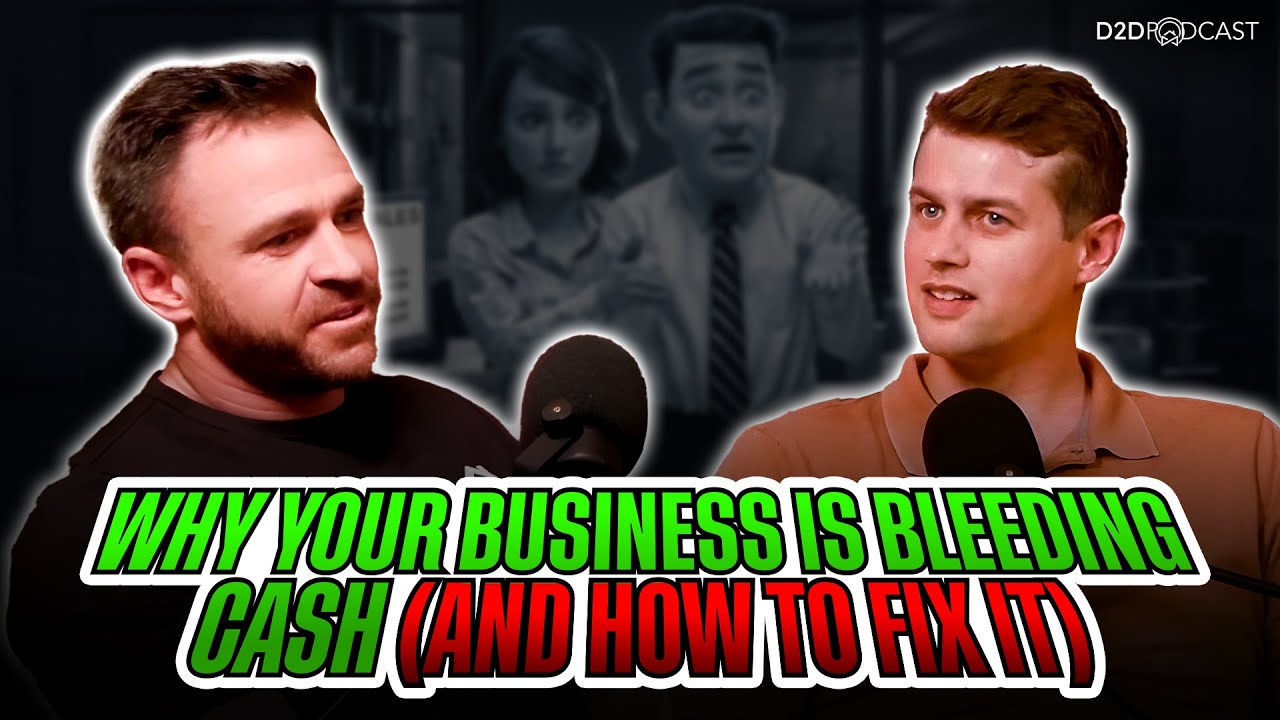
On this episode of The D2D Podcast, guest host Nate Hall sat down with Kurt, founder of Pivotl, a bookkeeping and fractional CFO service built for the trades. Kurt started out knocking doors as a 19-year-old, moved into the finance world, and now runs an entire outsourced finance department for solar, roofing, pest control, and door-to-door companies. The conversation is a blunt, practical look at the numbers that decide whether a home service business scales or stalls.
- A simple staffing benchmark, a profit-center breakdown, and tight control of cash and credit are the levers most owners are ignoring.
- Enterprise value, not this week's revenue, is the payout you are actually building toward, and most companies are not built to sell.
- Below one to two million in sales, the problem usually is not your books. It is your top line.
Why owners end up flying blind on their own numbers
Kurt's edge comes from range. Before Pivotl, he worked for a consulting company that served businesses doing anywhere from three million to two hundred million dollars a year, and the pattern was impossible to miss. The bigger, better-run companies all shared one habit.
Walk into one of them, he says, and there are "dashboards," "KPIs everywhere, tracking things," and leaders "making decisions based on data" instead of feel. Walk into a smaller company and the picture is very different. Often the owner is doing the bookkeeping, or a parent is, or a family member who stepped in. The books are a mess, nobody can answer basic questions about cost of goods or labor percentage, and half the time nobody can even find the login to QuickBooks.
The point of a service like Pivotl, Kurt explains, is to "bring that excellence in data and reporting" that you see in the big companies "down to the small 3, 4 million dollar range and make it affordable." And you do not need a full-time hire to get it. As he puts it, "a lot of times in marketing and in finance, you don't necessarily need someone full-time. You need an expert for 10 to 20 minutes." An expert can look at your financials for a few minutes and tell you where the real problem is.
The one benchmark every owner should know
If you take one number away from the episode, make it this one. Kurt offered it up unprompted as a free rule of thumb.
Kurt said: one person of overhead for every million dollars in sales.
He added: So if you've got five people in the office, you should be doing a minimum of 5 million in sales. And that keeps your overhead at about 8 to 10% in terms of your labor cost.
That single ratio reframes a conversation owners have all the time. When the office says it is overworked and needs another hire, the instinct is to post the job. But if your overhead labor is already running hot, adding a body makes the real problem bigger. Kurt's benchmark gives you a way to ask a sharper question first: is this a staffing shortage, or is it a role and process problem? He points to the companies he sees running lean, where "the best companies in the industry" keep office labor near 9%, while a struggling operation can sit at 18% without realizing it.
Find the division that is quietly draining your profit
Here is the moment that opens the episode, and it is worth sitting with. One of the first things Pivotl does with a new client is split the company into profit centers and tie every dollar of labor and materials back to the right unit. The results are often jarring.
Kurt said: One division is carrying the whole company. And every other division is losing money.
He explained: oftentimes one set of activities or business unit or type of work you're doing is just sucking all the profit out.
Nate shared a version of this from his own time running service in the solar space. He assumed his direct-to-consumer work was the winner. Once he actually looked at the data, his business-to-business work turned out to be far more profitable, because those jobs were faster and commanded higher margins. Without the numbers, he says, he "would have been doubling down on the wrong revenue stream." That is the whole case for clean financials in one story: the gut is confident, and the gut is often wrong.
Build enterprise value, not just this week's cash
This is where Kurt pushes hardest against the default sales mindset, and where the conversation gets most relevant for any owner thinking about an eventual exit. He drops a statistic that should stop you cold.
Kurt said: 90% of businesses that are for sale don't sell.
Why? He said: It's because they're not sellable.
The fix is a shift in what you optimize for. "In finance, there's this thing called enterprise value," Kurt says, and "when you go to want to sell your company, that's the biggest event as an entrepreneur that you can make. It is not the cash flow that you're making today." Enterprise value, he explains, "is going to be a business that has tangible systems, accounting systems, processes," plus intellectual property and cash flow. The advice is to start early: "the sooner you put those processes in place and you can start reporting on those numbers, that's the payout you want to work towards as an entrepreneur."
Being ready has a concrete definition. Kurt says prepared "means three years of financials" that show "positive cash flow, free cash flow." He also calls out a trap many owners fall into around taxes, the instinct to "spend every dollar so you show no profit." It feels smart in April, but as he points out, if you spend every dollar and show no profit, "who's going to buy that business?" A business that never shows it makes money is a business that is hard to sell for what it is worth. If you are curious where your company would land today, a Forge valuation is a useful reality check against these same standards.
The cash traps: comp plans, credit cards, and terms accounts
When Nate asked about the biggest mistakes he sees young companies make, Kurt went straight to cash, and he was specific.
The first is compensation. "Really spend time looking at how your comp plans affect your cash flow," he says. The goal is alignment: "you want to make sure that how we're compensating our reps ties in as closely as possible to how the company's getting paid." Paying out big money up front while you wait to get paid on the back end is how a growing company runs itself into a wall.
The second is loose spending authority. Kurt is emphatic here: "Do not give installers credit cards." Do not hand out an Amex with an employee card for everyone because it is faster. "You have to control expenses," he says, and his standard is strict: "every dollar that goes out, you make sure you approve that dollar."
The third is terms accounts, and this one has teeth. They "can really bury you," Kurt warns, describing the owner who runs jobs all month and then gets a bill for a hundred thousand dollars with no idea where it came from, long after the customer has paid and the job is installed. At that point you cannot go back and charge more. The margin is simply gone.
When the books are not your problem yet
One of the most useful things Kurt says is who he will turn away, because it keeps owners from spending money in the wrong place. If you are doing less than a million dollars a year, he is direct: "guys doing less than a million dollars a year in sales as owners, you have a sales problem." He extends that even higher, to the one-and-a-half to two million range, where he still believes the top line is the real constraint.
His prescription in that case is not a bookkeeper. It is to go fix sales first. For owners in that spot, that means building a repeatable sales engine and leadership bench before layering on financial infrastructure, the kind of foundation the OwnersOS business playbook is built around. Clean financials make a great business better. They cannot manufacture revenue that is not there yet.
Data, AI, and the "who not how" mindset
Running underneath the whole conversation is a theme: speed to good data. Kurt is bullish on AI in the back office, where Pivotl has built internal tools that pull supplier invoice information straight into QuickBooks. "What I think AI is super powerful in doing is speed," he says. "Speed to data." The bottleneck is not the models, it is the mess beneath them. In the trades, he notes, every supplier and CRM is different, so "the challenge with AI right now is just the consolidation of data."
The mindset that ties it together comes from a book Kurt mentions, Who Not How. New entrepreneurs, he says, meet every obstacle by asking "how am I going to fix this?" The better move is to ask a different question: "instead of asking how first, we ask who. Who can solve this problem for me?" For most owners, finance is exactly the place to apply that. It is the necessary work that pulls your attention away from the revenue-driving work you are actually great at.
That is the quiet argument of the episode. The owners who scale are not the ones who force themselves to love bookkeeping. They are the ones who get the right numbers in front of them, read them honestly, and build a business that is worth something the day they decide to sell.