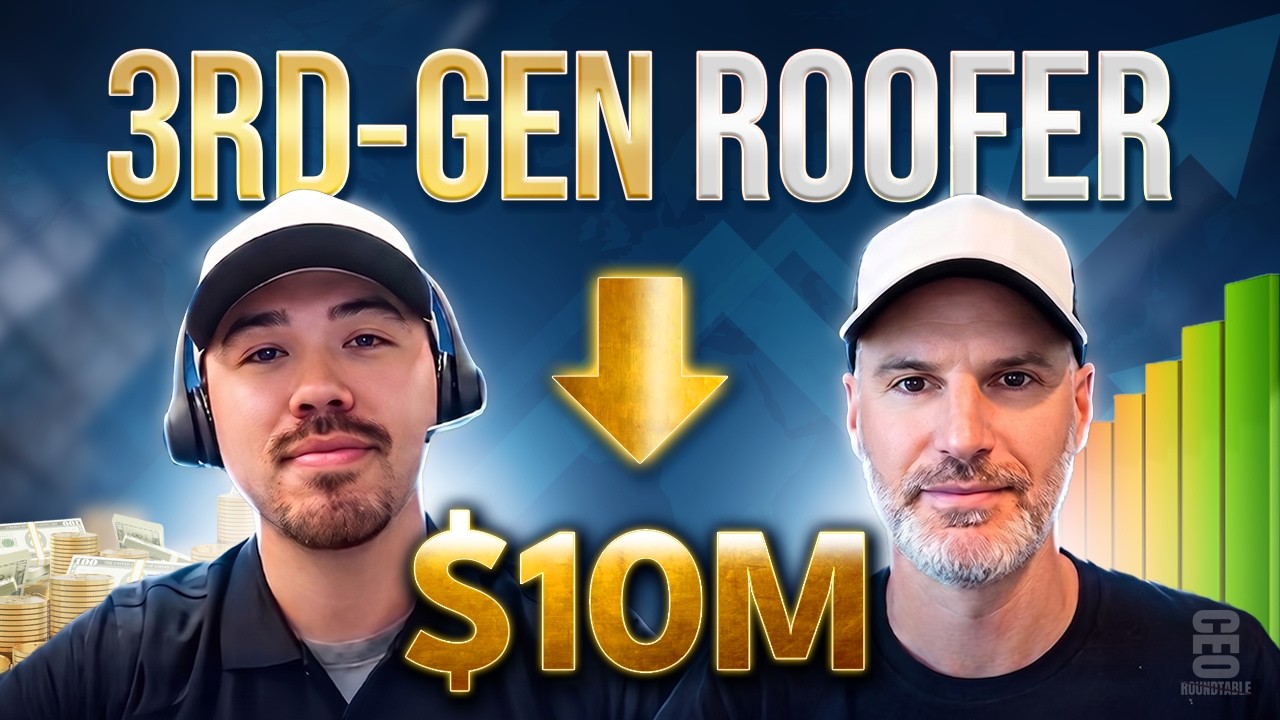
How to Scale a Roofing Business: Baja Roofing's Path From Owner-Operator Burnout to Nearly $5M


- The story: Third-generation roofer Jeremy Lara burned out as an owner-operator, went to sell for another roofing company, where he saw how a well-oiled machine is built, then came back and scaled Baja Roofing from $1.8 million in its first partial year to just shy of $5 million in year two.
- The lessons: Systems before speed, financial literacy before growth, the right "who's" in the business, and a clear focus on your one constraint across marketing, sales, operations and finance.
- The opportunity: Breaking into HOA and commercial work opened six-figure jobs where property managers only need three bids, compared with the five to seven bids common on residential.
Most roofing owners don't fail because they can't sell or can't install. They stall because the business grows faster than the foundation underneath it. On a recent episode of the Roofing CEO Podcast, host Mike Abramowitz sat down with Jeremy Lara, CEO and co-owner of Baja Roofing in the Los Angeles area, to talk about exactly that.
Mike noted Jeremy has "been in roofing for 15 years," has owned his company for two, and leads a team of "34 to be exact." The numbers: $1.8 million in the first year (a partial year that ran from August through December), just shy of $5 million in year two, and a pace for "eight to possibly even $10 million" heading into year three.
If you're figuring out how to scale a roofing business without breaking yourself, Jeremy's path is a useful case study.
The Owner-Operator Trap: Growing Too Fast on Your Own
Jeremy comes from a roofing family. "I'm a third generation roofer," he said. "My grandfather started a company. My dad, my uncle have their companies." His cousin is his vice president. As he put it, "it's in our blood."
That background gave him the trade, but not the business. In his early twenties, he was doing everything himself.
"I was an owner operator wearing all the hats, you know, installing roofs, selling roofs. Um, didn't really get too much familiarity with how to run the business on the back end."
Then he tried to grow faster than his systems could handle. "I actually got in over my head trying to grow too fast on my own as an owner operator," Jeremy said. "Things just were going south for me. I was pulling my hair out. I was just completely depleted with energy, uh, mentally and physically exhausted."
So he stepped away. "It came to a point where I just, you know, I, I hung up the towel."
Most owners will recognize this. The owner is the engine for everything, so the more the company grows, the more it depends on one exhausted person. That is a structure problem, not an effort problem.
Learning the System From the Inside
Jeremy went to sell for Resilient Roofing in San Diego, where Seth, who Jeremy calls a mentor ("He didn't even know it"), showed him how the business should run.
"It was there that he exposed me to how to really structure and organize a well-oiled machine with all the systems and processes behind the scene to lay out the foundation for scalability."
A few months later, a solar company approached him to build out its roofing division. He combined what he had learned running his own company with what he had seen at Resilient, and the results came fast: "within the first year, we scaled to about 30 roofs a month on the residential side. So there I learned how to really handle volume."
There was still one gap. "The only thing that I say I still didn't know was my financial literacy," Jeremy said. When net metering 3.0 passed, he said, the solar industry in California "just completely tanked." The company he was part of "was included in that."
The takeaway for owners
Ask yourself: if you stepped out of the day-to-day tomorrow, what would keep running? If the answer is not much, start there. Our guide on how to stop being the bottleneck walks through a practical first 30 days.
Coming Back to Build Baja Roofing
After solar, Jeremy came back to the family business. He and his cousin started Baja as "a branch off of my grandfather's original company in the 1970s." They didn't inherit that company; Jeremy named his business after it to honor his grandparents, who "raised me as a young child."
They started with what Jeremy already knew worked. "At first we, we just, we just wanted to implement the systems that I knew in the residential side," he said. "So we had a really clear foundation selling residential roofs. We can sell them like hotcakes. The system is so simple, it sells itself."
About a year in, they broke into HOA work, which meant getting "back into the commercial roofing game," where Jeremy first learned to roof. He credits the growth to "systems we have on the residential side and our HOA connections and the network that we've made this past year."
Financial Literacy: Find the Leak Before You Scale
Mike raised cash flow, warning about the owner who buys "a Lambo or a boat" and 18 months later says, "oh shoot, I can't make payroll." Jeremy started with an admission about his solar years.
"When things started going south, I didn't know why. I didn't, I didn't know where to look or how to audit myself or even how to, I didn't even know what a P&L was at the time."
When he started his own company, that was "the first thing that I attacked." He described three steps.
- Get educated. He went to "workshops and getting mentorships" to learn how to structure the company "financially so we can actually retain the cash that's coming in."
- Audit every job. "Money's coming in and money's coming out just as fast," he said, so he started "auditing every single job that came in" and learning "how to price it out correctly to get a certain amount of gross profitability."
- Know your break-even volume. He worked to know "exactly how much revenue not only that we need to sell, but that needs to be produced to, uh, satisfy our overhead."
Then he put the right people in place. "A lot of who's, not how's," he said, a nod Mike connected to Who Not How by Dan Sullivan and Ben Hardy. "The who's that I implemented into the business keep track of all of that for me so I can have a really good financial forecast so I can make sure that we're not scaling too fast on a really weak foundation and just completely tank."
Financial discipline is not about slowing growth. It keeps growth from collapsing under its own weight. For a weekly view of the numbers that matter, start with a home service scorecard.
Splitting Verticals: The Three-Year Plan
When Mike asked where Jeremy wants Baja to be in three to five years, Jeremy laid out a clear structure.
"Early on in Q1, we've separated two verticals in my business," he said: residential on one side, HOA and commercial on the other. On the residential side, he said, "we went and looked at, uh, D2D Experts to help us scale the residential division as its own vertical entirely," and plans to separate the two "legitimately by having the two different licenses associated with the residential and the commercial and HOA."
The split also gives him options. "We may potentially be interested in, um, getting acquired by PE on the residential side, but the commercial and HOA side is going to be my baby."
"My three-year plan is to scale this to $20 million in revenue with a 15% net profit with all the people in place so I don't have to be part of the day-to-day."
His role: "I can be the visionary and focus on expansion and relationship building and revenue growth." That doesn't mean stepping away. "I still, I like working," he said.
Why this structure matters
A cleanly separated division is easier to measure, manage and value on its own, which keeps future choices open. If a sale or partnership might be in your plan, roofing owners can get a starting point with a Forge valuation.
Simplify, Then Find Your Constraint
Mike asked how Jeremy went from startup to approaching $10 million so quickly.
"For me, it was just a matter of just simplifying everything," Jeremy said. When you're starting out, "you have so many things to do that sometimes you end up doing nothing, um, because you don't have the guidance on what to implement and where to implement it at inside your business."
"Once I learned to just kind of clear the noise in my business and focus on what's actually my constraint and learning the differences between a constraint and bottlenecks and what to focus on first..."
One metric he called out was the time it takes "from the sale to collect the money," because that cash is what lets him "put the money back into my business to reinvest." Once he figured out "those key metrics," he said, "it really just helped me expand and grow my business really fast."
That is the approach he now teaches through his coaching program, Scale Method. He has broken it into "four simple components, which is, you know, marketing, sales, operations, and finance," and the work is learning "how to tell which part of those pillars is your constraint in your business and how to identify that constraint and then how to work on it."
Look at the four areas, pick the one holding everything else back, and fix it before adding anything new. Our one-page home service business growth plan is a good place to put that on paper.
Mentorship Is an Investment, Not a Cost
Asked what he would tell young roofers coming up, Jeremy didn't hesitate.
"So my one piece of advice is to get some mentorship... talk to somebody that's where you want to be and then just skip the years of pain and suffering and have the framework and the roadmap laid out for you."
"A lot of people look at mentorship as a cost, like it's going to cost me $10,000 or $20,000 instead of the investment, instead of what they can, you know, 10x or 100x with that investment and that mindset."
Jeremy went through Breakthrough Academy when he started the business because "I needed some coaching." He also sees how far many owners have to go: "You'd be surprised on how many freaking roofers don't even know what a CRM is."
Breaking Into HOA and Commercial Roofing
Before wrapping up, Jeremy wanted to talk about what he called "a whole another world to roofing that a lot of these residential roofing companies don't know about": the commercial and HOA side. "It's a lot simpler than they think," he said.
His playbook comes down to relationships:
- Know your ideal client. "Really identifying your ideal client avatar for commercial and HOA is going to be key."
- Network with the right people. "Who you know and networking is absolutely key. But a lot of times you don't know who to network with or how to attract those clients."
- Play the long game. "It's a long-term play, but if you can weather the storm, it's going to return you dividends like tenfold."
The size of the work is the draw. "We're closing deals that are six figures like on a daily basis now," Jeremy said. "We're finishing a job that's a $600,000. And that's maybe somebody's entire revenue for a year, and that's just off one job."
"These are HOA communities," he said. "It's just the same as the residential job that you're doing, but just on a larger scale."
"It's a red ocean right now on the residential side. You're having to deal with minimum three bids if you're lucky, but usually five to like seven. Where in the HOA side, these property managers only need to get three bids."
Those property managers "are unattached to who gets the job done," he said. "So you're one of three people." His view: "if you come in and you play the game correctly, you can 10x your business if you're doing under a million dollars like within 24 months."
Note the order: Jeremy built the residential system first, then added HOA work, then planned to split the two into separate verticals.
Key Takeaways: How to Scale a Roofing Business
- Build systems before you chase volume.
- Learn your numbers early. Audit every job and know what you must sell and produce to cover overhead.
- Hire the "who's" to track finances and forecast.
- Find your one constraint across marketing, sales, operations and finance.
- Separate business lines on purpose to keep options open.
- Treat mentorship as an investment, not a cost.
Jeremy summed up his outlook near the end of the episode: "We're in the age of collaboration, no more gatekeeping." Find people who have already built what you're building, and borrow the roadmap. For more on the stage-by-stage path, read how to scale a home service business.