How to Scale a Pest Control Business


- Delegation is the ceiling: Natura Pest Control's owners say a business cannot grow past what one owner's hands can touch, so building a hire-train-develop-delegate system is the real unlock.
- Reinvest before you reward yourself: The fast path to scale is riding the grind, putting money back into people, systems, and software instead of buying the lifestyle too soon.
- Pay for other people's mistakes: A mentor, a coach, or even a 32-dollar book lets you skip the expensive lessons other owners already paid for.
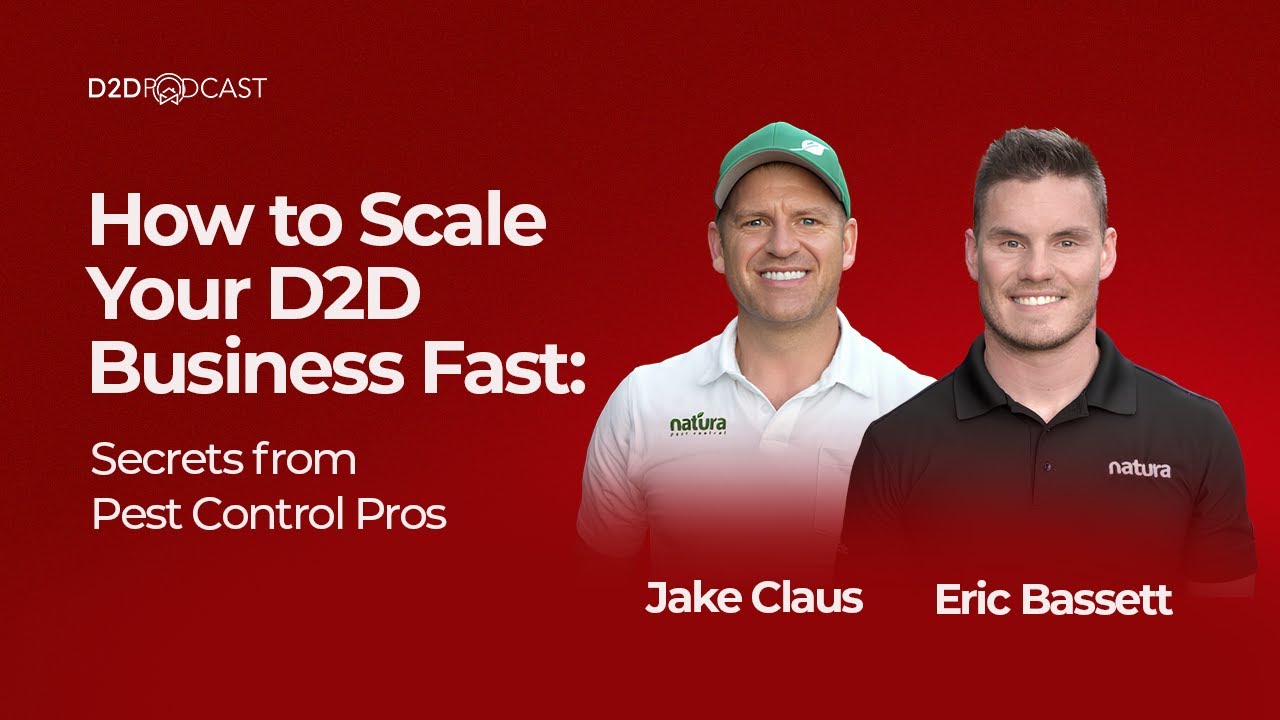
Most home-service owners think the thing holding them back is leads, reps, or marketing. On this episode of The D2D Podcast, Sam Taggart sits down with Eric Bassett and Jake Claus, co-hosts of the Bug Bux Podcast and owners of Natura Pest Control, and the real bottleneck turns out to be the owner. Learning how to scale a pest control business is less about working harder and more about letting go of the roles you are holding too tightly. Here is what two pest control operators who grew from a truck and a spray rig into a coaching community of thousands say actually moves the needle.
Why Pest Control Owners Hit a Growth Ceiling
The first wall almost every owner hits is simple: they are doing everything themselves. When Sam asked what the number one pitfall is for a small business owner trying to scale, Jake Claus went straight at it. A one-man show cannot carry a growing company for long, and the harder the owner grips every function, the lower the ceiling on all of them gets.
Eric Bassett describes what that looks like in practice. The owner wears the sales hat, the office hat, and the service-technician hat, and every one of those jobs ends up run at a mediocre level while the owner feels completely burned out. They are pouring everything into the business and still cannot understand why other companies are pulling away. The problem is not effort. It is that effort does not scale the way a system does.
Jake Claus: as long as they're holding on tightly to everything, their business won't grow past what their hands can touch. So you need to bring on more people that can reach farther than you and reach better than you.
The Hire, Train, Develop, Delegate System
Delegation is the answer every owner has heard, but Eric argues that it fails because owners treat it as a vague idea instead of a repeatable process. His fix is to turn it into something you can draw on a whiteboard and hand to your team.
He describes it as a clockwise circle with four stages. "Up at the top is just hiring," he says, getting the right people in the door with real hiring practices. Next comes training, getting new people the right information quickly and effectively. After that is development, growing a person into the role you believe they can fill. And then last is delegating, handing off the tasks eating your time so that you free yourself up and give your people room to grow. Then the cycle repeats as that person gets promoted and trains the next hire.
The insight underneath it is that owners usually have no shortage of good ideas about what the business needs. What they lack is a system to quantify the actual target and move it off their own plate. Build the circle into your company's philosophy and delegation stops being a mood and becomes a machine.
Spend Money to Make Money: Investing to Scale
Here is where most owners freeze. In pest control, where a customer might only be worth a hundred dollars every other month, spending on a hire or a coach feels impossible when cash is already tight. Sam framed it as three competing forces an owner juggles: control, meaning the belief that nobody can do it as well as you; funds, meaning the money going out before you can see it come back; and fear of an unknown return.
Jake's answer is to treat the business like you treated your body as a rep. As a door-to-door salesperson you invested in sleep, exercise, and reading because you saw a direct line to performance. Ownership demands the same discipline aimed at the company instead of yourself.
Jake Claus: I need to invest in another technician. I need to invest in an office staff person. I need to invest in good software. I need to invest in someone who knows more about this than I do so that I don't make the same mistakes that other people have made... If I want a real advantage here, I've got to spend money to make money.
Sam pointed to a client named Jonas with Turf Badger in Michigan as proof. Jonas was a guy with a little company who did not know what he did not know, found help through Sam and The D2D Experts, and did not just take the business to the next level, he blew it up. As Eric put it, scaling often comes down to firing yourself from a job and hiring somebody to do it better.
Reinvest Before You Reward Yourself
The second trap is lifestyle. Jake and his wife started Natura Pest Control in Vancouver, Washington in 2013 with a truck, a spray rig, and almost no money. They lived in a dumpy apartment that smelled like mold, drove a Kia minivan, and ate ramen for two years. His point is not that suffering is the goal. It is that your expectations have to match your stage, and that a step backward is only a problem if you decide to stay there.
Jake Claus: ride the grind for a while... take that money, reinvest it back into your business. And then, in five, 10 years, that business could be the thing that gets you the extravagant lifestyle that you do deserve... but you have to understand the timelines to actually do it. But it's always an investment.
Sam tells a similar story against himself. He drove a Kia as the number one rep at Vivint because he refused to get locked into a lifestyle loop too early. When he finally bought an exotic car, the dealer warned him that nobody goes backward in that game, that once you start high you are ruined for anything less. The lesson for owners is the same: reps who make three hundred grand at twenty-three and spend like it have nothing left to reinvest when they start a company and payroll, taxes, and services paid over two years eat the margin. Real scaling comes from micro-investments into people, process, and technology that pay off years later, not from upgrading your truck this quarter.
Pay for Other People's Mistakes
The cheapest way to scale is to skip the lessons someone else already paid for. Sam calls it exactly that. "I'm paying you for your mistakes," he says of mentors and coaches, "and so I don't have to pay for my mistakes." He uses a story about a friend who bought a roofing conference, ran it in the spring, and lost close to a million dollars, including two hundred grand on audio-visual that Sam produces for forty. One conversation would have saved that owner a hundred and sixty thousand dollars, and as Eric added, it would have saved it every year after that.
Jake makes the same case about books. Someone can spend a career making mistakes, distill it into a digestible book, and sell it for thirty-two dollars. For a fraction of a coaching fee, business classics like Traction have changed how owners think, run systems, and operate. The ROI only shows up, both of them stress, if you actually do the reading and the work. A mentor, a mastermind, or a shelf of the right books is not an expense. It is a shortcut past the tuition you would otherwise pay in lost time and money.
Protect Your Time, Priorities, and Grit
Once a business starts working, the new challenge is that opportunities come faster than you can take them. Eric says the hardest skill he has had to learn is saying no the right way, picking the few things that are the best use of his time and politely declining the rest even when it twists his gut. Sam runs the same filter: there is what he does and what he does not, and if something does not fit his buy box, he passes on it.
Eric adds a warning about doing hard things without a plan. The fastest growth is usually expensive and uncomfortable, and the thing that moves you furthest is often the hard work you are avoiding. But take the hard road without the right systems and philosophy and you land right back at square one. Sam calls that the double hard: you did the hard thing and got nowhere, which is just more hard.
Finally, both come back to grit. Sam calls it the three dead grandmas principle, the pattern where the least successful people always seem to have a fresh crisis every week while the people actually running businesses quietly power through real problems without making them everyone's excuse. "The highlight reels come with the dark side," Sam says, and too many people give up too soon to ever reach them.
How to Scale a Pest Control Business
Use this as a simple checklist to turn the episode into action:
- Name the roles you are hoarding: List every hat you wear (sales, service, office) and mark the ones only you can truly do.
- Run the delegation circle: For each role you can hand off, hire, train, develop, then delegate it so your people reach farther than you can.
- Reinvest on a timeline: Decide what percentage of profit goes back into technicians, office staff, and software before you raise your own pay.
- Buy other people's mistakes: Add one mentor, coach, or event, plus a short stack of business books you will actually reread.
- Define your buy box: Write down what you will and will not say yes to, so new opportunities get filtered instead of absorbed.
- Protect the timeline: Expect the real payoff in years, not quarters, and keep showing up through the hard seasons.
Frequently Asked Questions
What is the number one reason pest control businesses stop growing?
According to Natura Pest Control's owners, the top reason is the owner trying to do everything. A one-man show can hold customer service, service tech work, and sales in balance for a while, but the company cannot grow past what the owner's own hands can touch until roles are delegated to capable people.
How do I delegate when I cannot afford to hire?
Treat the first hire as an investment, not a cost. The owners describe a hire-train-develop-delegate cycle: bring in the right person, train them fast, develop them into the role, then hand off the tasks eating your time. Even if it pinches early, it frees you to work on growth instead of in the daily grind.
Is hiring a business coach worth the money for a small company?
The episode makes the case that a mentor lets you pay for someone else's mistakes instead of your own. One example cited an owner who would have saved around a hundred and sixty thousand dollars a year from a single conversation. The return shows up over years, so the value depends on actually applying what you learn.
How long does it really take to scale a home-service business?
Plan in years, not quarters. Natura's owners ate ramen for two years and reinvested heavily before the business funded a better lifestyle. Their advice is to ride the grind, reinvest profit back into people and systems, and expect the extravagant payoff on a five to ten year horizon, not immediately.
What should an owner invest in first when scaling?
The owners point to technicians, office staff, good software, and knowledge from someone further ahead. The mindset is the same discipline reps use on themselves, spending time, effort, and money where it drives performance. The goal is to avoid repeating mistakes others have already made and paid for.
Final Takeaway
Scaling a pest control business is not a sales problem, it is an ownership problem. The owners of Natura Pest Control grew by building delegation into a repeatable system, reinvesting before rewarding themselves, paying for other people's mistakes through mentors and books, and protecting their time and grit through the hard seasons. If you are the ceiling on your own company, the work is to hire, train, develop, and delegate your way out of it. Start by mapping the roles only you are holding, and build the system that lets your business grow past your own two hands.