Home Service Marketing Beyond the Door Knock: Turn the Leads You Already Have Into Revenue


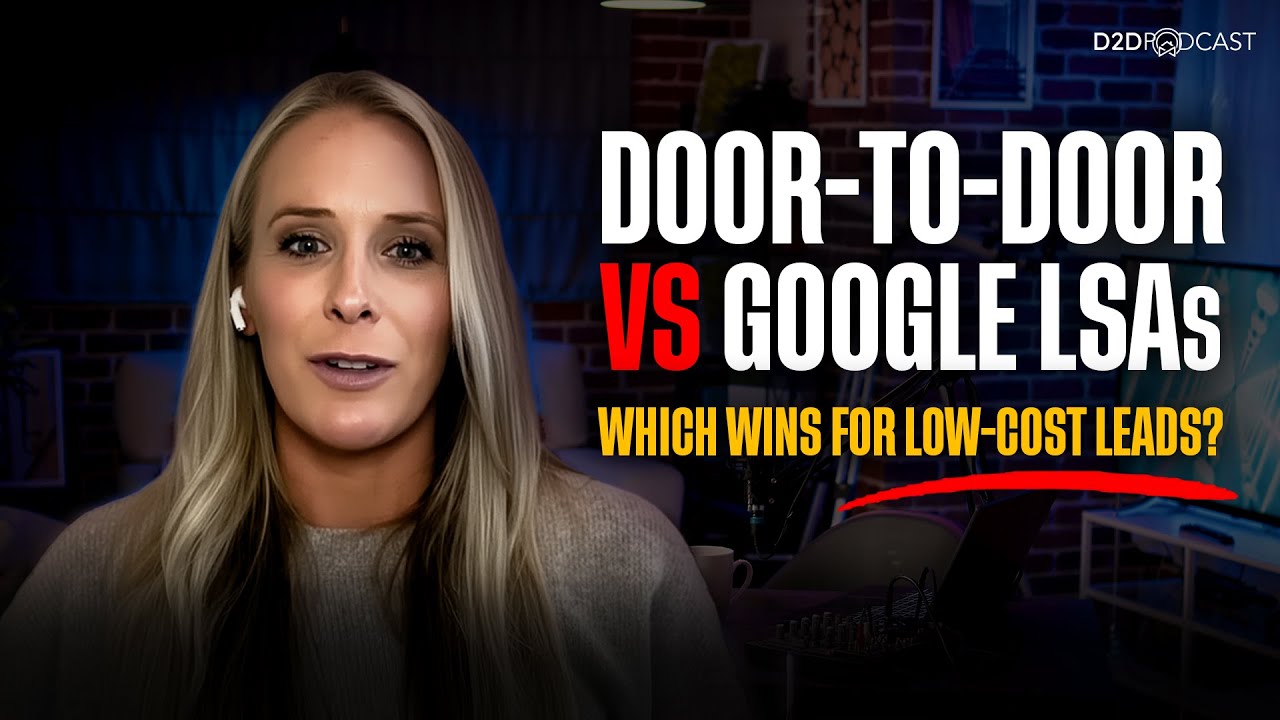
- The core idea: On the D2D Podcast, Digital Natives Media founder Brianna Fitzpatrick explains why home service marketing should extend the trust your reps build at the door, not replace it.
- The quick wins: Follow up on leads that never closed, build reviews on Google, post raw video, and ask happy customers for referrals.
- The system: Track every lead with CallRail and UTM codes, put sales and marketing in the same room, and size your budget to the data you need.
Most door-to-door companies are built on one channel. Reps knock, homeowners say yes or no, and the team knocks again tomorrow. That works until growth stalls and the owner realizes the business has no way to reach the hundreds of people who already raised their hand once.
That is the problem this episode of the D2D Podcast takes on. The guest is Brianna Fitzpatrick, founder and CEO of Digital Natives, a Phoenix-based digital advertising agency. In the episode's introduction she is described as having "over 1 million per month in ad spend under management," with a team that specializes in paid search, paid social and SEO. The host, who came up through door-to-door alarms and solar and now works as Sam Taggart's internal marketing director, pushes her on one question: what should a field-sales company actually do with marketing? Her answers make a useful playbook for any home service owner.
Home Service Marketing Starts After the First Sale
Brianna opened with a point most owners skip. The sale is not the finish line.
"Yes the sale is important but the life cycle marketing after the fact is so important. You can make or break somebody's trust that way."
She described her own pool service as the model. After every visit the company emails her the pH level, a photo of the clean pool and the service details. It does not feel like marketing, but it is.
The host agreed from his own sales career: if a customer has to pick up the phone to ask where their project stands, "you're not doing a good job." Brianna added the business consequence. When customers go looking for an update, "it also makes it so that they have the opportunity to look for another brand." An automated text, like a seasonal reminder that "it's time to clean your gutters," keeps you in front of them without adding work to your team.
For an owner, this is a systems question. The same discipline that makes a home service sales process coachable and consistent should govern what happens after the contract is signed.
Get Found: Google Business Profile, Reviews and Social Video
When the host asked what reps and managers can do to show up online without a marketing department, Brianna started with the basics.
- Google My Business. "Making sure that they're visible on Google My Business... because it's still the number one search engine out there."
- Yelp and reviews. Get your team incentivized to collect reviews, or simply run an internal friendly competition. "You'd be surprised at how quickly that can build your profile and it gives you authority within all of those platforms to show up faster."
- Social video. Many home service companies assume nobody books a re-roof from Instagram. Brianna said "you would be surprised at how underrated that is."
She pointed to a window washing company whose young crews wear pink t-shirts and post funny TikTok videos, and people remember them. The host had a similar story from a bootcamp at headquarters in Sandy, Utah, where two attendees from West Palm Beach showed up in branded pink overalls and cowboy hats. They were the ones he remembered.
Raw Beats Polished
The host argued that owners often waste the budget on cameras and editors. Brianna agreed and was direct:
"It doesn't have to be high production. It shouldn't be high production. It should be off the cuff, something funny, something memorable."
Phone cameras and microphones are good enough. Overlay text so people can follow with the sound off, and win the opening: "the first... five seconds is pretty crucial to capture somebody's attention."
For topics, she suggested case studies with willing customers, the state of the industry, and the questions reps hear over and over at the door, "because if they've heard it a couple times, there's likely a lot more people that are asking the same question." For platforms, "I would say Instagram and TikTok for sure," using the same video on both to start, because "you'd be surprised with just being consistent how much visibility you can get."
Google Ads vs. Local Services Ads: Know What You Are Paying For
About 60% of the business Digital Natives runs goes through Google Ads and YouTube, Brianna said, with roughly 30 to 35% on Meta and TikTok. On Google, ads reach "people who are actively searching for your services." YouTube calls for "more like informative type content. That's going to be more of a long-term play."
The most practical part of the conversation was the difference between Google Ads and Google's Local Services Ads.
"Local Service Ads, where you only pay on a cost per lead versus a cost per click."
"If your cost per click is really high, it can make your cost per lead really expensive and not profitable."
Local Services Ads give you less control over targeting, and visibility ties back to your Google business listing: "when you have more reviews, when you have more authority there, your ad by default is going to get more visibility." She said her team has seen Local Services Ads "increase lead volume and revenue for one of our clients by 30% in 90 days," while for other businesses, depending on price point, standard Google Ads are more cost-effective. Her rule: "you just kind of have to look at the numbers and see what makes the most sense."
That only works if you know your numbers. If you are not already tracking close rate and cost per acquisition every week, start with a home service scorecard and the unit economics of scaling.
Feed the Algorithm Real Sales Data
Brianna made a point that separates profitable campaigns from expensive ones. The ad platforms learn from what you tell them.
"Once you feed it enough data... it can turn into a very well-oiled machine."
That means tracking more than web form fills. Her team recommends "something called CallRail... which will actually track the phone calls from the different platforms that we're advertising on." They then check the client's CRM to confirm which leads became closed deals and send that back to Google, Meta or TikTok. In her words, "it gives the algorithms more bottom-funnel data to optimize from."
She also puts "a UTM code... on every single piece of creative or an ad that we're running," so the team can see "which keyword, what targeting tactic... which ad itself actually drove that lead, how far they went down the funnel." The host's reaction: "They need to be on everything."
Stop Running Sales and Marketing in Silos
The host described a familiar meeting: marketing works hard on targeting and testing, and sales says the leads are bad. Brianna's answer:
"Marketing and sales can't be looked at in silos. They have to be looked at as a cohesive department."
"The leads are only as qualified as what sales tells us they are."
Her team asks for CRM access and a weekly touch base with the sales team, because "a lot of notes get missed when it comes to what to put into a CRM." With one roofing client in the Pacific Northwest, they go through the phone call log every week and adjust: maybe "we need to focus more on maintenance versus... re-roofs for right now," or target zip codes where homeowners are more likely to have the budget for a full replacement.
The host framed the owner's job clearly. Sales feedback has to be useful: "Not complaints, not laziness. We need true and honest feedback because that helps us go back to the drawing board."
The Biggest Leak: Leads That Never Closed
The sharpest moment came when the host described a conversation with a member of their mastermind group who "runs a successful roofing company. They do seven figures a month in rev." The host asked what happens to every lead that enters the database and does not close.
"And he was like, nothing."
Brianna's fix starts with the list you already have.
"Take all of those emails that haven't converted or those phone numbers, shoot them a text... especially if it's within the last seven to 14 days because they likely haven't made a decision."
From there she recommended:
- Weather triggers. "I would also have some kind of automation in place for after storms or when there's severe weather."
- Education, not just promotion. "People don't necessarily always know what they need until it's put in front of them." Her example was an email showing older homes how much proper insulation could lower an energy bill.
- Retargeting. Load the list into a remarketing campaign or feed it to Meta or Google when you launch paid ads.
- Repetition. "It's going to take two, three, four, five touch points potentially to get somebody to actually call them back." The goal is that when the need comes, they remember your name. "You just have to consistently be in front of them."
The host knew this firsthand. When a new baby kept him off the doors, he asked his solar company for old, canceled and disqualified leads, sent them a mass text, and "got like six sales from that." As he put it, "The phrase is the fortune is in the follow-up, right?"
Old-School Channels That Still Work
Brianna was not dismissive of traditional media, but she wanted proof. "Radio is just really hard to put an ROI to in a traditional sense, whereas streaming, you can have the data to back up if it's actually generating leads for you." She is a fan of connected TV: "I actually really love connected TV and I think that every brand should do it if they can."
The host offered a counterexample: a solar company in California's Central Valley he did retargeting work for focused on radio, and "Everyone knew who they were." Brianna agreed it depends on the company, its audience and its market.
She also shared an idea most home service owners have never tried: partner with real estate agents or mortgage brokers and "have a flyer that goes in every single closing package. People are constantly moving, buying homes." When the host noted solar can be awkward for agents, she said "pest control would be a great one for that."
How to Budget and Start: A Six-to-Twelve Month Plan
The host asked how she would onboard a door-to-door pest control company with no marketing department and a budget of $8,000. Brianna would start with what the company already has.
- Begin at the bottom of the funnel. "Start with their bottom funnel metrics," review the contact data already collected, and launch "something like a Google Ads that's very low funnel" to reach people actively searching while prospecting content gets built.
- Model the economics. Understand "the average lifetime value... what their estimated conversion rate is from lead to, to closed customer," and build a forecast "for six to nine months." A one-time roofing job and a pest control plan a customer keeps for years are very different math.
- Define success up front. Agree on "what the number of leads are that they need per month for it to be considered a successful campaign."
On minimums, Digital Natives ideally wants clients spending "at least $2,500 a month," because below that the data comes in too slowly to make decisions and "everybody gets frustrated." At that level she would "normally stick with one platform" and add from there.
Referrals: The Cheapest Channel You Are Not Using
Brianna's last recommendation was the easiest. "Put together a referral program." Ask customers who have been with you for a year to refer friends and family for a discount. "It's a very easy way to drum up more business because they clearly already trust you."
The host shared a referral raffle he ran for that same radio-focused company, which had a huge client base and had never tried referral campaigns.
Host: "I think that raffle alone based off of closed deals was like 3.5 million in revenue for a Traeger grill."
Brianna Fitzpatrick: "That cost them $300."
What This Means for Owners
The host closed with a warning for owners who plan to handle all of this themselves while also "running the day-to-day operations, managing the finances" and leading the sales team: "that's a lot to think you can just all of a sudden one day become a marketer as well."
Door knocking is not dead. But a field-sales company leaves money on the table when every lead lives only in a rep's phone. Build the follow-up, the tracking and the weekly sales and marketing review into your operating system, and the doors your team already knocked keep paying. If you want more ways to grow without simply buying more leads, read how to grow a home service business without just buying more leads. And if you run a roofing company and want to know how buyers would value a business with these systems in place, see what your roofing company is worth.