How to Grow a Roofing Company From a Small Crew Into a Real Business

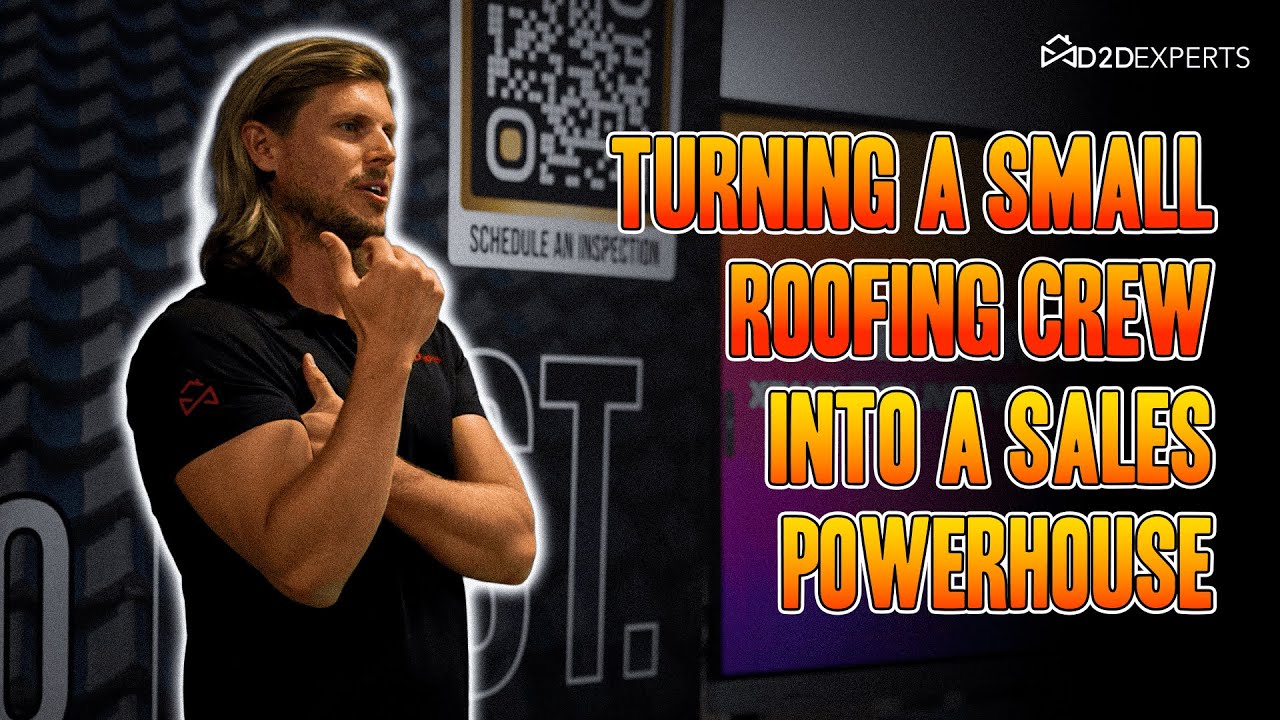
- The visit: Sam Taggart returned to PACC Solutions in Chicago, a roofing company he first worked with in 2021 when it had only a handful of sales reps, and ran an all-hands session for the whole company.
- The lesson: Owners overestimate what they can do in one year and underestimate what they can do in five, and the companies that grow are the ones that invest in culture, team and infrastructure instead of pulling out every dollar of profit.
- The first step: A roofing company is not a real business while the owner is producing most of the volume. Step one is building a sales team, a go-to-market and a brand that produce revenue without you.
Most roofing owners can remember the early days clearly. A few reps, a truck, a garage full of shingles, and an owner who sells, inspects, manages crews and answers the phone. What is harder to picture is what that same company could look like five years later if the owner kept building instead of just grinding.
In this episode, Sam Taggart, who in his own words helps "scale D2D businesses," got to see that picture in person. He went to Chicago to work with PACC Solutions, a roofing company he had first consulted years earlier. As he put it on camera: "Michael and his wife have put an amazing company together."
This post breaks down what Sam saw, what he taught the full PACC team, and the single piece of advice he gives every roofing company that wants to grow from a small crew into a business that runs without the owner in the field.
Five Years Changes Everything for a Roofing Company
Sam's first session with PACC was small. When the team reminded him of the date, they said it was "our first year, 2021." Sam described the group back then this way: "you guys had what, like four, five, six people? Like it was small."
Coming back gave him something consultants rarely get, a before and after. "Not many times you get the opportunity to go to a company, come out, consult, and then see them four or five years later," he said.
That gap is the first lesson, and it applies to every home service owner reading this.
Sam Taggart: You overestimate what you can do in one year, but we underestimate what we can do in five.
Sam explained why so many owners never see the five-year version of their company. "We don't often times think far enough in our lives to actually accomplish something great because we're like squirrels." He compared it to watching his kids run around on a hike, chasing a new "squirrel" every few minutes. "I watch us in life a lot of times, we don't stick to something long enough to actually realize something great."
For a roofing owner, the squirrel problem looks familiar. A new lead source this quarter, a new product line the next, a new sales script after a slow month. None of it gets enough time to compound. The owners who build real companies pick a direction and stay on it long enough for the results to stack.
What this means for your planning
- Set a five-year picture of the company you want, not just a revenue number for this year.
- Judge your systems on whether they are building toward that picture, not on whether they paid off in the first month.
- Expect year one to feel slower than you hoped. That is normal, and it is not the measure that matters.
Get Your Whole Company on the Same Path
What made this visit different from a typical sales training was who was in the room. "They brought me out for the whole company," Sam said. "Not just the sales people, this isn't just a rah-rah, not going out knocking, but it's the actual entirety of their all hands."
That meant customer service, project managers, crews and everyone in between. Sam framed the challenge he was there to solve: "How do you still teach every one of their employees to have synergy? And as a business owner, that seems to be a difficult piece, right?"
Every roofing owner who has grown past a handful of reps knows this tension. Commission reps are wired one way. In Sam's words, "some of them are 1099 and they have to go eat what they kill." Salaried staff are wired another. Sam was blunt about the risk: "some people have a lot of employees that are just kind of bumps on the log." And the cost of that gap shows up directly in output.
Sam Taggart: Even though you're paying the same amount, then some of your employees you might be only getting 50% of the effort.
His goal for the day was simple: "let's see what we can do to maximize their energy, maximize their efforts."
How owners can close the effort gap
The episode does not lay out a step-by-step program for this, but the principle is clear: culture is not just for the sales floor. If only your reps hear the mission, the rest of the company will treat the sale as someone else's job. A few practical ways to apply that idea:
- Bring every department into the same all-hands, not just the sales meeting.
- Show office staff, project managers and crews how their work affects the customer the rep promised.
- Give non-commission roles clear targets so they can see what a great week looks like.
If you want a deeper framework for building that kind of shared standard, our guide on how to build a sales culture that actually sticks walks through it.
Invest in Culture, Team and Infrastructure
The first thing Sam showed on camera was not a sales board. It was the gym inside PACC's office.
"Talk about an awesome culture. I mean, this is their gym in their office," he said. Then he contrasted it with what he usually walks into: "a lot of times I go to a roofing company and you got random manila folders all over the floor, shingles in some garage. You walk into this office and you got some vibes."
He was clear that the space was a signal of something deeper. "You can tell that they're on a mission, they care about their reps, they've invested in the actual culture."
Sam Taggart: I think a lot of companies are short-sighted. They try to take all the profits and they're like, you know, how do I just make as much money as possible instead of like, if I can invest in culture, team, infrastructure, how do I actually scale?
This is the trade-off at the center of growing a roofing company. Every dollar of profit can go into the owner's pocket or back into the business. Owners who always choose the pocket often stay stuck at the size where they can personally hold everything together. Owners who reinvest in people, space and systems build something that can carry more volume than they could ever handle alone.
Authentic beats polished
One detail Sam loved had nothing to do with money. "This wall is probably my favorite wall I've ever seen in a roofing company," he said, describing PACC's process laid out on paper towels on the wall. "It is just on paper towels. But I actually think the authenticity of it is what's culturally cool."
The takeaway for owners: your process does not need to be pretty to be powerful. It needs to be visible, real and used. A process your team can see every day beats a beautiful binder nobody opens.
Swing Hard, and Let the Work Shape You
During the all-hands, Sam shared a story from his own business that shows what the five-year mindset costs in real life. He paid developers to build an app for what he called his "human development system." It was supposed to take six months. He planned a launch at D2DCon, built banners and spent heavily on it. The launch kept slipping.
"So I missed three years of like a big event that I'm supposed to launch this human development system," he said. In the end, the project did not ship. "So I just spent four years, 500 grand on an app that is just going to live in the ether for now."
What he took from it is the part worth keeping.
Sam Taggart: I think the bigger lesson was I swung, I went hard, and I chalk it up for the game.
Sam Taggart: Sometimes it's the man in the making by developing those things.
He went further: "the person you're becoming and what it's shaping you oftentimes is much greater than maybe the outcome."
For owners, this reframes what a failed initiative means. Not every investment in your company will pay off on schedule. Some will not pay off at all. The owners who keep growing are the ones who swing anyway, learn from the miss, and do not let one bad outcome stop them from building.
The Story You Tell Shapes the Company You Build
Sam also walked the PACC team through an idea he called confirmation bias. "We approach things with a lens and we create a story with everything we do," he explained.
He used a simple example. If you have been bitten by a snake, "my natural lens is that snake might bite me." If you are a snake handler, you just go grab it. "It's the snake is a snake and you are you. It's just how am I approaching this is my story."
The point for the team was that they are writing their own story, every day. "You guys are building a story," Sam told them, and he set out to help them "be more intentional about finding the story in which you want to write."
He tied that to curiosity. "We're all told curiosity killed the cat," he said, before rejecting it. "Curiosity is what starts innovation. Curiosity is what actually creates growth. Curiosity is what actually creates learning and... understanding."
Applying the story idea as an owner
- Notice the story your team tells about your company. Is it "we are a small crew that gets by," or "we are building something that will be dominant in five years"?
- Reward curiosity. The rep or project manager who asks why a process works the way it does is often the one who improves it.
- Tell the five-year story out loud and often, so new hires join the company you are building, not just the one you have today.
Lean Into What You Are Good At
Sam closed the human development part of the session with his own path into door to door. His grandma asked, "when are you going to get a real job?" He planned to do sales through college and then get a normal job, "and then hope to go get a $70,000 salary where in four months I made a half a million dollars."
He remembered driving home across Texas after his second summer, swearing he would never come back, and then seeing his paychecks. His conclusion: "I had the gift of gab. I could talk to people. I was willing to work... Why would I go be an engineer when I'm good at talking to people?"
The owner lesson is about the people in your company, too. Your best growth comes from putting each person, including you, where their strengths actually produce. For many roofing owners, that means stepping out of the work they are used to doing so they can focus on the work only they can do.
The Biggest Tip for Roofing Companies: Stop Being Just a Roofer
At the end of the visit, Sam gave his single biggest piece of advice for roofing owners.
Sam Taggart: Don't be a roofer that just is a roofer. Meaning, you're the guy that's doing all the production.
Sam Taggart: Nobody wants to buy, nobody wants to really call it a real business if you are the one producing more than 70, 50% of your volume.
He described the goal plainly. "Really a roofing company should be you're not producing any of the volume and your sales team, your lead aggregation, the way that you go to market, your name, your brand is producing the revenue despite you."
And he called it the foundation for everything that comes after. "That's like step one of running a roofing company is just get to that point and then we can talk about scaling and duplicating that process."
How to start getting out of production
The episode is clear about the destination. Here is a simple way to think about the path:
- Measure it. Find out what share of your volume you personally produce today. If it is most of it, you know where the work is.
- Build the sales team. Your reps, not you, should be carrying the closing load. Our guide to stepping out as the bottleneck lays out a 30-day plan.
- Own your go-to-market. Lead aggregation, the way you go to market and your brand should generate demand without relying on your personal network.
- Build leaders. A leadership team that lets you step back is what keeps the machine running when you are not in the room.
Sam's point that "nobody wants to buy" an owner-dependent company also matters if you ever plan to sell. If you want to understand how a buyer would look at your roofing company today, Forge Strategic Equity offers a roofing company valuation.
Bringing It Together
PACC Solutions went from a small group at its first session in 2021 to a company with a gym in the office, a visible process on the wall, and an all-hands that includes customer service, project managers and crews. That did not happen in one year. It happened because the owners kept investing in culture, team and infrastructure long enough for it to compound.
If you are running a roofing or home service company today, the path Sam laid out is simple to say and hard to do:
- Think in five-year chapters, not one-year sprints.
- Get every department on the same path, not just the sales team.
- Reinvest in culture and infrastructure instead of taking every dollar out.
- Swing hard, and learn from the misses.
- Get out of production so your team and your brand produce the revenue.
For more on scaling past the owner-operator stage, see how Baja Roofing scaled from owner-operator burnout and how Tucker Pies went from sales manager to roofing CEO.